
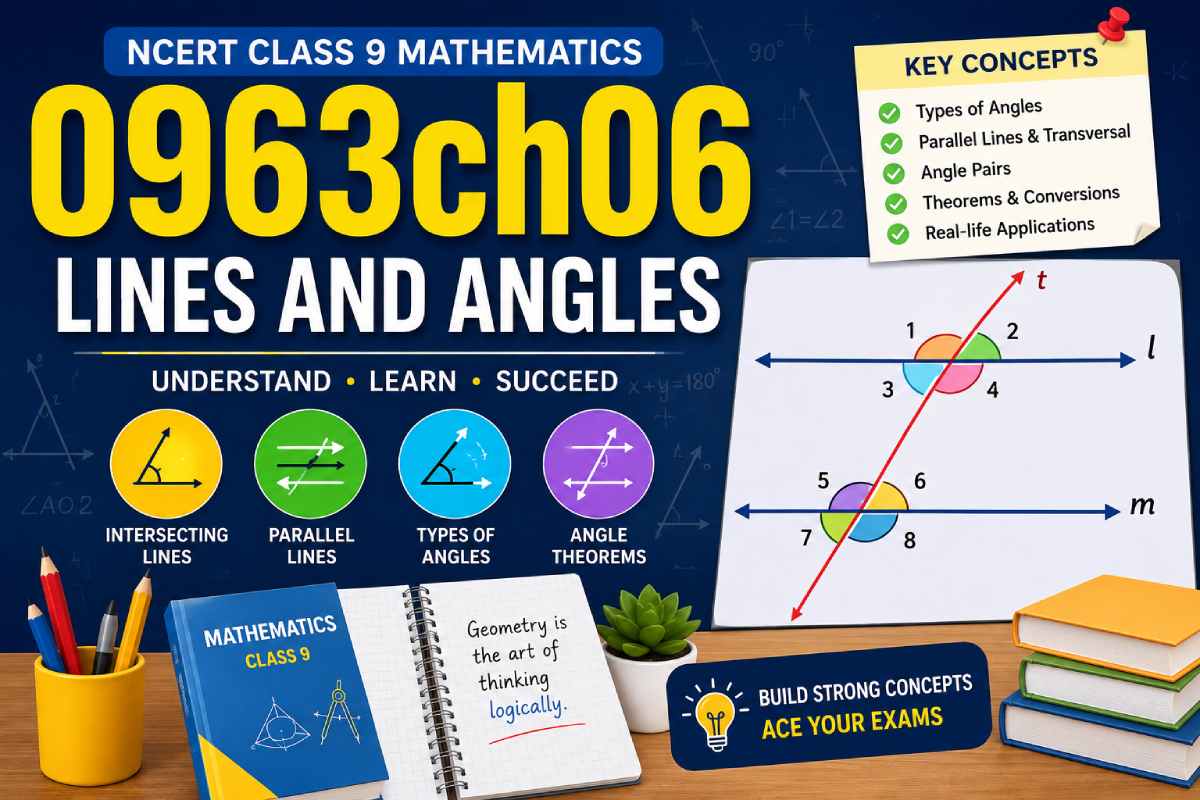
Introduction 0963ch06 refers to NCERT Class 9 Math Chapter 6 Lines and Angles. This chapter is one of the vital topics in geometry that deals with angles, lines and transversals and makes them one of the prerequisites for complex geometric problems studied in the higher classes. Learning 0963ch06 can aid you with solving geometrical proofs …
This article is part of
Apps
Introduction
0963ch06 refers to NCERT Class 9 Math Chapter 6 Lines and Angles. This chapter is one of the vital topics in geometry that deals with angles, lines and transversals and makes them one of the prerequisites for complex geometric problems studied in the higher classes. Learning 0963ch06 can aid you with solving geometrical proofs and various proofs, spotting the relationships between angles, and using logic to make calculations in many cases, so it is a chapter you can’t ignore. Learn 0963ch06 from the NCERT Class 9 Mathematics book, and start building your foundation for advanced learning and competitive examinations.
What is 0963ch06?
NCERT Math’s Class 9 Solutions Chapter 6 Lines and Angles. The chapter deals with types of lines like intersecting and parallel lines, angles formed when lines intersect each other and the theorems concerning parallel lines and a transversal. Students are also taught angle relationships and to logically prove various statements based on geometrical axioms, postulates, and theorems instead of simply memorizing them.
Students often use digital tools and mobile applications alongside their studies to explore information and manage everyday tasks. If you are interested in learning about mobile app features and installation, visit our guide to Honista Download for more details.
Main Topics Covered in 0963ch06
The chapter includes several important geometry concepts.
| Topic | Description | Importance |
| Basic Terms | Line, ray, line segment, intersecting lines | Forms the foundation of geometry |
| Types of Angles | Acute, right, obtuse, straight, reflex, complete | Helps classify angles correctly |
| Adjacent Angles | Two angles sharing a common arm | Used in many geometric problems |
| Linear Pair | Adjacent angles adding up to 180° | Frequently appears in examinations |
| Vertically Opposite Angles | Opposite angles formed by intersecting lines | Always equal |
| Parallel Lines | Lines that never intersect | Essential for theorem-based questions |
| Transversal | A line crossing two or more lines | Creates several angle relationships |
| Angle Theorems | Corresponding, alternate interior, co-interior angles | Core of Chapter 6 |
Basic Geometry Concepts
Geometry begins with simple objects.
- Point: Indicates an exact location.
- Line: Extends infinitely in both directions.
- Ray: Starts at one point and extends endlessly in one direction.
- Line Segment: Has two fixed endpoints.
These concepts help students understand how different figures are formed.
Drawing and visual practice can help students understand shapes, lines, and angles more clearly. For more creative inspiration and easy drawing ideas, explore our guide to simple drawing ideas, which can be useful for personal or educational projects.
Types of Angles
Angles are measured in degrees and classified according to their size.
| Angle Type | Measurement |
| Acute Angle | Less than 90° |
| Right Angle | Exactly 90° |
| Obtuse Angle | Between 90° and 180° |
| Straight Angle | Exactly 180° |
| Reflex Angle | Between 180° and 360° |
| Complete Angle | Exactly 360° |
Identifying the type of angles, is one of the earliest skills that students learn when they study 0963ch06.
Intersecting Lines and Angle Relationships
When two intersecting lines create angles, they adhere to several important rules. Here are some examples:
Vertically Opposite Angles
When two lines intersect:
- Opposite angles are equal.
- This property is used frequently in proofs.
Example:
If one angle is 75°, the vertically opposite angle is also 75°.
Adjacent Angles
Adjacent angles:
- Share a common vertex.
- Share one common arm.
- Do not overlap.
These angles may or may not be equal.
Linear Pair
A linear pair consists of two adjacent angles whose non-common arms form a straight line.
Property:
Sum of a linear pair = 180°
Example:
If one angle is 110°
Second angle = 180° − 110° = 70°
Parallel Lines and Transversal
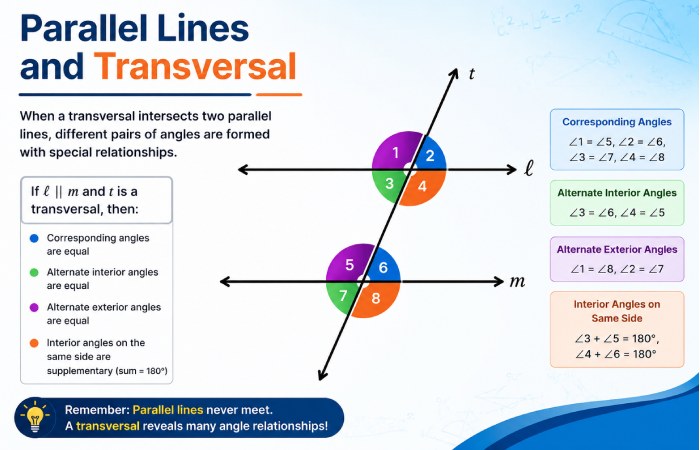
“The idea which is one of the first and one of the main topics for 0963ch06 that deals with parallel lines and transversal.”
A transversal creates several pairs of angles that follow predictable relationships.
These relationships make solving geometry problems much easier.
Angle Relationships with Parallel Lines
| Angle Pair | Property |
| Corresponding Angles | Equal |
| Alternate Interior Angles | Equal |
| Alternate Exterior Angles | Equal |
| Co-interior (Same Side Interior) Angles | Sum = 180° |
These properties are repeatedly used in NCERT exercises.
Important Theorems in 0963ch06
The chapter introduces several fundamental theorems.
Theorem 1
If two parallel lines are cut by a transversal, then:
- Corresponding angles are equal.
Theorem 2
If two parallel lines are intersected by a transversal:
- Alternate interior angles are equal.
Theorem 3
When parallel lines are cut by a transversal:
- Interior angles on the same side of the transversal are supplementary.
Their sum equals 180°.
Converse Theorems
The chapter also explains the converse.
If:
- Corresponding angles are equal
or
- Alternate interior angles are equal
then the two lines must be parallel.
Those converse sentences are SO extremely useful for proving somethings.
Problem-Solving Techniques
Students should follow a certain method when answering geometry questions.
| Step | Explanation |
| Draw the diagram carefully | Accuracy is essential |
| Mark all known angles | Prevents confusion |
| Apply relevant theorem | Use the correct angle relationship |
| Write every mathematical reason | Important for scoring full marks |
| Verify the final answer | Ensure logical consistency |
Common Formula Summary
| Concept | Formula |
| Linear Pair | 180° |
| Angles Around a Point | 360° |
| Vertically Opposite Angles | Equal |
| Corresponding Angles | Equal (Parallel Lines) |
| Alternate Interior Angles | Equal (Parallel Lines) |
| Co-interior Angles | Sum = 180° |
The following two relationships must be learnt as it often occur in the papers.
Real-Life Applications
Geometry may not seem all that practical but geometry in our real world can actually prove to be really useful.
Examples include:
- Architecture and building construction
- Bridge engineering
- Road and railway design
- Interior decoration
- Computer graphics
- Robotics
- Mechanical engineering
- Navigation and mapping
Along with educational resources, readers may also be interested in exploring guides about digital platforms and mobile services. Visit our article on Tokki Master Jio to learn more about this topic.
Tips to Master 0963ch06
Success in this chapter depends more on understanding than memorization.
Some effective study tips include:
- Learn each theorem with its proof.
- Practice drawing neat diagrams.
- Revise angle properties regularly.
- Solve NCERT textbook exercises multiple times.
- Attempt additional geometry questions for better accuracy.
- Understand why each theorem works instead of memorizing answers.
- Label every angle carefully while solving proofs.
Consistent practice improves logical thinking and problem-solving speed.
Common Mistakes Students Should Avoid
Many students lose marks because of simple errors.
| Mistake | Correct Approach |
| Confusing corresponding and alternate angles | Identify the transversal carefully |
| Forgetting to mention reasons | Write the theorem used in every step |
| Incorrect diagrams | Draw accurate figures |
| Assuming lines are parallel without proof | Use given information or theorem |
| Calculation mistakes | Double-check angle sums |
Avoiding these mistakes can significantly improve exam performance.
Importance of 0963ch06 in Higher Mathematics
The concepts introduced in this chapter are used throughout secondary mathematics.
Students encounter these ideas again in:
- Class 10 Geometry
- Coordinate Geometry
- Trigonometry
- Circles
- Construction
- Mensuration
- Engineering Mathematics
A strong understanding of Lines and Angles makes future geometry topics much easier.
Conclusion
Lines and Angles the 0963ch06 chapter about one of the basic topics of school geometry will make students understand concept of interesting lines, parallel lines, transversal and various relations in angle.. By proving theorems and solving questions based on different topics in geometry students build their concept for complex topics in higher class. By practice for this topic one will be able to get higher marks in the examination.