
Both platforms unify fraud and AML on one system with no-code rules and real-time decisioning, so this comparison does not resolve on feature lists. It resolves on where each platform generates its signal and what that costs you to run. If pre-transaction signals such as session behavior, device fingerprinting, and bot or account-takeover detection are …
Flagright vs Sardine for Fraud and AML
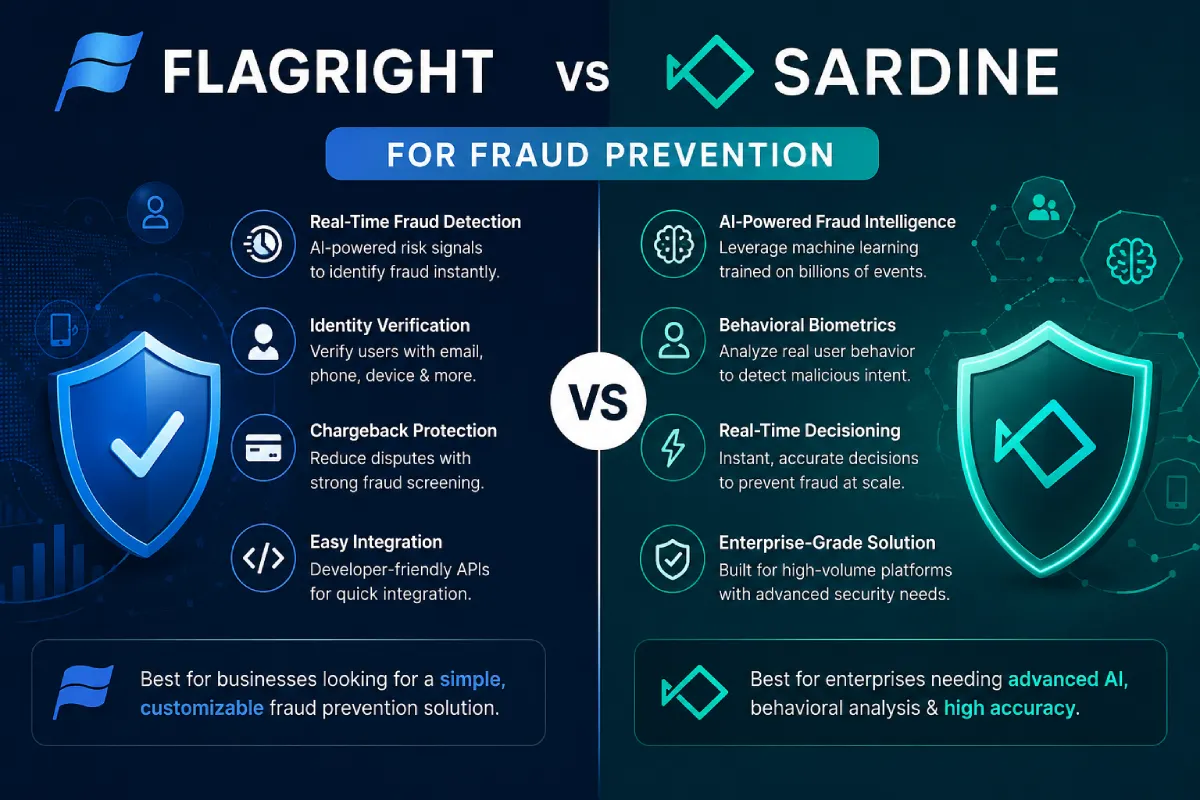
Both platforms unify fraud and AML on one system with no-code rules and real-time decisioning, so this comparison does not resolve on feature lists. It resolves on where each platform generates its signal and what that costs you to run.
If pre-transaction signals such as session behavior, device fingerprinting, and bot or account-takeover detection are the specific gap you are solving, Sardine is built for exactly that. If your requirement is an auditable AML and fraud program that a compliance team can operate and change on its own, across multiple jurisdictions, live in weeks and without instrumenting your client applications, Flagright is the stronger fit.
This article is part of
Business
Comparison at a glance
| Criterion | Flagright | Sardine |
| Source of signal | Transaction, behavioral, and customer risk data via server-side API | Device intelligence and behavior biometrics via SDK, plus consortium and enrichment data |
| Coverage | Transaction monitoring, watchlist screening, risk scoring, case management, AI Forensics, governance workflows | Identity verification, fraud prevention, AML monitoring, case management, sponsor bank oversight |
| Integration | Single server-side API, all payment methods, no client SDK required | Lightweight SDK combining device and behavior, plus API |
| Decision speed | Rules in milliseconds, sub-second API response, blocking in milliseconds | Fraud decisioning reported under 150ms |
| Configuration | Natural language rule creation, no-code nested logic, 100+ typology-tagged scenarios | No-code rule editor with bundled rulesets across fraud and AML use cases |
| Testing | Shadow mode on live traffic plus 90-day backtesting with recommended thresholds | Rulesets testable against the last 30, 60, or 90 days before pushing to production |
| Investigations | AI Forensics inside case management, evidence and narrative prepared pre-review | Auditable workspace with AI summaries, granular permissions, two-person review on high-risk decisions |
| Explainability | Decisions tied to model version, versioned scoring logic, exportable audit logs | Machine learning models over 4,000+ engineered fraud features |
| Filing | FinCEN SAR plus goAML in 70+ countries, AI-drafted narratives | AML monitoring with case management and SAR filing |
| Deployment options | SaaS, hybrid, or on-premise | Cloud platform |
| Implementation | As little as two weeks | Scoped per engagement, volume-based licensing |
Detection approach
Sardine’s approach is signal-first. It analyzes device-level signals and user behavior patterns during active sessions, cross-checks against its consortium, and enriches with identity, email, phone, banking, and payment data. From billions of sessions it has engineered over 4,000 fraud features, evaluated in real time through its rules engine and used to train its machine learning models, with those features also available to customer data science teams building custom models. For fraud that manifests before a transaction exists, such as fake account creation, bot attacks, and social engineering scams, that is a genuinely different class of signal from transaction monitoring.
Flagright’s approach is control-first, operating on transaction, behavioral, and customer risk data rather than session telemetry. Detection logic is authored, tested, and owned by the compliance team:
- Natural language rule creation. Describe the pattern in plain English; the platform parses intent and pre-fills rule logic, thresholds, and typologies. No engineers at any step.
- 100+ pre-configured, typology-tagged scenarios ready to customize.
- Nested no-code logic covering behavioral patterns, dynamic thresholds, and multi-variable risk orchestration.
Risk scoring layers underneath. A KYC risk score covering who the customer is combines with a transaction risk score covering what they are doing into a customer risk assessment that drives decisions, with thresholds adjusting automatically to live risk scores across customer risk levels without manual rule segmentation.
Verdict: Sardine leads on pre-transaction and session-level fraud signal. Flagright leads on transaction-level detection your team controls end to end. These are complements as much as substitutes, and the question is which is your actual gap.
Integration and operational footprint
This difference deserves more weight than it usually gets in evaluations, because it determines who does the work and what obligations follow.
Sardine’s device and behavior signals come from an SDK deployed across your customer-facing surfaces. That is what makes the signal possible, and it is not a criticism of the design. It does mean integration reaches into your app and web codebase rather than staying in your backend, and it means collecting device fingerprinting and behavioral telemetry, which independent reviewers note carries data governance obligations: a documented legal basis, clear notices, purpose limits, retention rules, access controls, and privacy-rights processes. Institutions in strict privacy regimes should scope that work before signing.
Flagright integrates server-side. A single API ingests all transaction types, from SWIFT and ACH through to on-chain flows, with no client-side instrumentation required. Reported integration is around a week against an industry norm of two to four months, with full deployment in as little as two weeks. One customer described the API as extremely modular, built for a wide variety of use cases and able to manage substantial complexity, with a seamless setup process. Reliability is stated at 99.99% uptime, and deployment is available as SaaS, hybrid, or on-premise, with on-premise offering complete control over sensitive data with zero external storage. For institutions with data residency mandates, that option matters and is not universally available in this category.
Verdict: advantage Flagright on integration surface, deployment flexibility, and the absence of client-side telemetry obligations.
Configurability and time to a live control
The platforms are closer here than anywhere else, and Sardine deserves credit for it. Its no-code rule editor ships with bundled rulesets across identity verification, high-risk device, AML transaction monitoring, payment fraud, deposits and withdrawals, and card issuing risk. One customer described building complex rulesets for new fraud patterns, testing them against the last 30, 60, or 90 days, and pushing them straight to production when they perform.
Flagright’s differentiation is the layer above that. Rules can be authored in natural language rather than assembled by hand, and a rule can move from concept to live in about 60 seconds. Calibration runs two ways before anything reaches a queue:
- Shadow mode runs a candidate rule against live production traffic into a private alert feed analysts never see, so you observe real behavior with zero disruption to the operational queue.
- Backtesting runs it against 90 days of history and returns alert volume, false positive rate, and a recommended threshold before a single alert lands in the queue.
One customer reported implementing new detection rules in minutes rather than weeks, which mattered because they process payments across six regulatory jurisdictions. Another noted testing entirely inside Flagright without building QA metrics in external tooling.
Verdict: near parity on no-code rule building and historical testing. Advantage Flagright on natural language authoring, shadow mode against live traffic, and automatic threshold recommendations.
Alert workflow and investigations
Sardine’s case management brings alerts, evidence, reviewer actions, AI-generated summaries, risk evaluations, and final decisions into an auditable workspace, with granular permissions and two-person review on high-risk decisions. Its network analysis explores relationships across users, devices, IP addresses, phone numbers, addresses, payment activity, and crypto accounts to surface laundering rings and mule activity.
Flagright runs AI Forensics natively inside case management rather than alongside it:
- Investigations begin automatically, with evidence, typology matches, and recommendations assembled before an analyst opens the case.
- Agents collect evidence, analyze activity, generate narratives, and log decisions inside the investigation view, using the same workflow logic and interface used to assign work to human analysts.
- Linked entities, transaction flows, and suspicious networks are visualized inside every case.
- Live customer risk scores are embedded as continuous AI decision inputs.
- QA runs inside case management with configurable scoring and audit-ready evaluations, alongside dashboards for workload, investigation speed, SLA adherence, and analyst throughput.
- An AI narrative copilot generates context-aware case closure narratives, with reported reductions in case closure time and improved narrative accuracy.
Customers describe the effect consistently. One team reported almost entirely eliminating narrative writing time. Another emphasized that AI Forensics delivers analysis and documentation nearly instantly while the team retains control over outcomes. Automation is staged rather than binary: you choose how AI Forensics handles alerts, from silent evaluation through to full automation.
Verdict: both offer auditable workspaces with AI assistance. Advantage Flagright on pre-populated investigations, in-platform QA, and graduated automation control.
Explainability and governance
Sardine’s detection rests substantially on machine learning models trained over engineered fraud features. Independent reviewers advise buyers to scrutinize false-positive reduction claims in this category generally, on the reasonable ground that a system can reduce false positives by flagging less, and to verify that permission and review controls apply to their specific configuration with audit exports supported.
Flagright treats explainability as architecture rather than reporting. AI agents operate inside governed investigation workflows with human oversight preserved. Every decision ties to a specific model version. Audit logs export in JSON or Excel for regulatory submission. Every scoring change, override, simulation, and recalculation is logged with timestamp, user attribution, and change history, with versions comparable and instantly reversible, and approval workflows enforced by role before changes go live. Analysts get clear explanations and supporting evidence for each rule hit. One customer described the practical result: each version is reviewed and documented, so when an audit arrives the proof already exists.
Verdict: advantage Flagright on decision-level traceability and change governance, which is the harder requirement to retrofit.
Reporting and multi-jurisdiction fit
Sardine supports AML monitoring with case management and SAR filing.
Flagright automates SAR filing to FinCEN and goAML filing across more than 70 countries, with SAR templates auto-selected based on the jurisdiction detected in the workflow and narratives pre-filled from case data, transaction history, and investigation output for analyst review. One customer described managing multi-jurisdiction requirements with clean rule separation and reporting aligned to local data obligations.
Note for balance: G2 reviewers who rate Flagright highly on interface and support have also said reporting features have room to improve, and one Capterra reviewer noted the dashboard takes some time to learn before it becomes intuitive. Raise both in your evaluation if they bear on your program.
Verdict: advantage Flagright on jurisdictional filing breadth.
Which fits your institution
Choose Flagright if: your requirement is an auditable AML and fraud program rather than a pre-transaction fraud signal layer; you operate across multiple jurisdictions and need goAML breadth with clean rule separation; your compliance team should own detection logic without engineering or vendor tickets; you need every detection and scoring decision traceable to a model version; you have data residency requirements that call for hybrid or on-premise deployment; or you want integration confined to your backend rather than instrumented across client applications.
Consider Sardine if: session-level fraud is your primary loss vector, meaning bot attacks, fake account creation, account takeover, or social engineering scams caught before a transaction exists; you want device intelligence and behavior biometrics bundled with identity verification in one contract; you have data science capacity to consume raw fraud features for custom models; or you are a sponsor bank wanting program-level oversight across sponsored fintechs.
The recommendation
For institutions building or replacing a financial crime compliance program, Flagright is the stronger choice.
Sardine is a capable platform and its device and behavior signal is a real technical asset, particularly for consumer fintechs whose losses concentrate in account opening and takeover. Nothing here suggests otherwise. But that signal is a fraud detection input, not a compliance operating system, and it arrives with an integration surface reaching into your client applications and a telemetry footprint that carries its own governance work.
Flagright’s argument is narrower and, for most buyers at this stage, more load-bearing. Rules live in about 60 seconds, calibrated in shadow mode against live traffic and 90 days of history before a single alert reaches a queue. Screening logic tuned to your risk appetite against data providers you choose. Investigations arriving with evidence and a drafted narrative attached. Every scoring change versioned, attributed, and reversible under enforced approval. Filing across 70+ goAML jurisdictions. SaaS, hybrid, or on-premise. Live in two weeks, on a single server-side API.
The two are not mutually exclusive, and some institutions run a session-signal layer alongside a compliance platform. If you are choosing one system to carry your AML and fraud program and answer to a regulator, choose the one built for that job.
Run both through a proof of concept on your own data and measure three things. Time from contract to first live rule. Engineering hours for a threshold change once live, and where in your stack that work lands. Whether an analyst can explain any given alert decision end to end from what the system puts in front of them.

Dbusinesspractices
Saleena Begum shares expert insights on business growth, digital marketing, and profitability, helping entrepreneurs and professionals make smarter, data-driven decisions.