
The future of AI in automotive isn't a concept being debated in R&D labs — it's happening on production lines, inside vehicle software stacks, and across the supply chains of every major OEM right now. And for digital business leaders paying attention, the scope of the transformation is considerably wider than the self-driving narrative that …
How AI Is Rebuilding the Automotive Industry
The future of AI in automotive isn’t a concept being debated in R&D labs — it’s happening on production lines, inside vehicle software stacks, and across the supply chains of every major OEM right now. And for digital business leaders paying attention, the scope of the transformation is considerably wider than the self-driving narrative that tends to dominate headlines.
Autonomous vehicles are part of the story, but they’re only one chapter in a much longer book — one that spans how vehicles are designed, manufactured, operated, serviced, and personalized over a lifetime of use. Understanding the full arc of that transformation is increasingly a competitive requirement, whether you’re an automotive player, a technology supplier, or an enterprise building adjacent to the mobility space.
AI at the Design Stage: Before a Single Bolt Is Turned
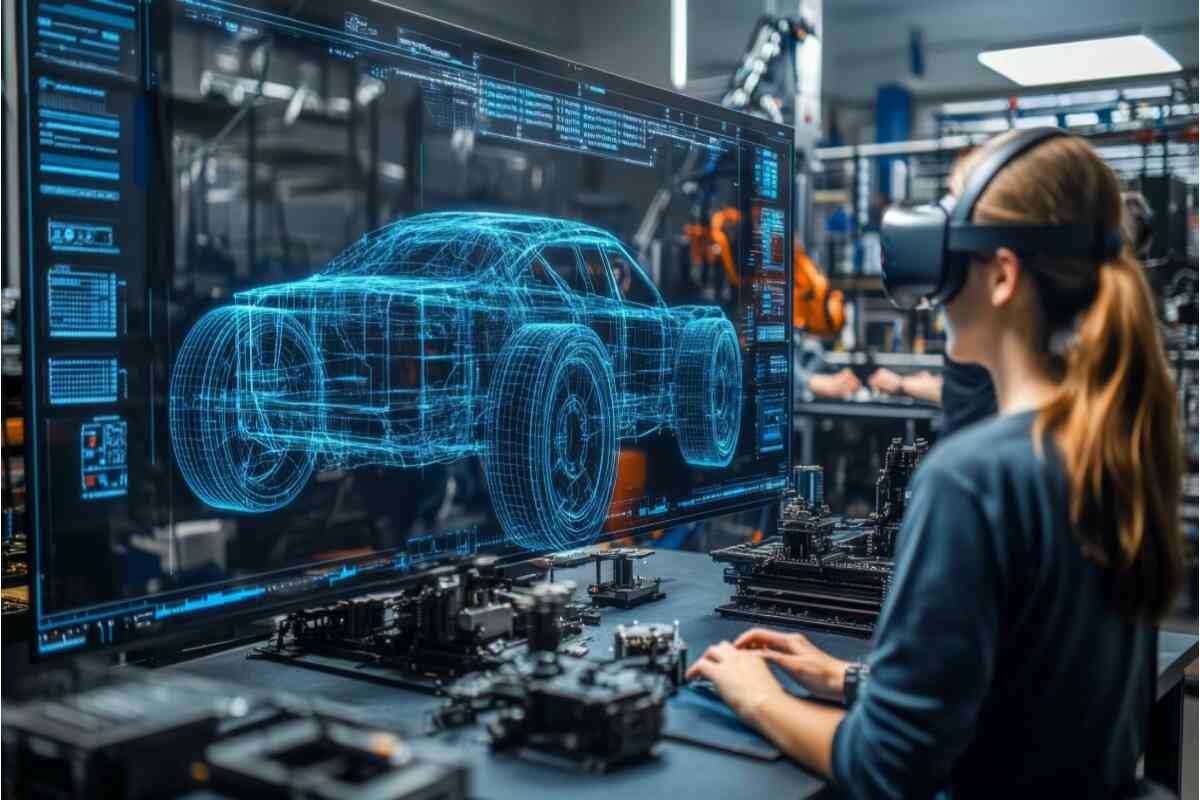
Generative AI is reshaping vehicle design from the ground up. Engineers are using AI-driven simulation to optimize tire tread patterns for traction and durability, run computational aerodynamics through virtual wind tunnels, and accelerate battery chemistry research that would take years through conventional materials science alone. What used to require physical prototyping and iterative testing can now be modeled, stress-tested, and refined in software — compressing design cycles and surfacing performance improvements that human engineers might never have found.
Battery management systems are a particularly compelling example. Once a vehicle is in production, AI algorithms can analyze real-time battery performance, identify weak cells, and adjust charging behavior to reduce strain — improving both safety and longevity. The battery doesn’t stop getting smarter when it leaves the factory. That’s a meaningful shift in how automotive value is created and sustained post-sale.
The Factory Floor: Precision, Quality, and Supply Chain Intelligence
Inside manufacturing facilities, machine learning — especially computer vision — is outperforming human inspection at scale. Vision systems can detect micro-defects in components that are invisible to the human eye, applied consistently across every unit rather than through statistical sampling. Marginally better quality at multiple points in the assembly process compounds into a significant overall improvement in vehicle reliability.
Supply chain management is equally ripe for AI-driven optimization. The automotive industry runs on just-in-time manufacturing, where inventory missteps carry direct margin consequences. Deep learning models can synthesize data across anticipated demand, product mix, seasonality, and supplier variables to deliver procurement guidance that legacy analytics simply can’t match. In an industry where thin margins meet complex global supply chains, that capability is not a nice-to-have.
In-Vehicle AI: The Car as a Software Platform
This is where the story gets most interesting for digital business practitioners. The modern vehicle is increasingly a software-defined platform — a networked compute environment generating continuous streams of operational data. AI systems embedded in that environment enable a range of capabilities that didn’t exist when the vehicle was shipped.
Predictive maintenance is the most immediate example: AI can detect anomalies in vehicle behavior that signal a component issue before it becomes a roadside failure, enabling proactive service interventions that improve customer experience and reduce warranty costs. But the opportunity extends further. Vehicle AI can enable dynamic personalization — learning driver preferences and adjusting cabin environment, driving dynamics, and infotainment behavior over time. It can support over-the-air software updates that genuinely improve the vehicle rather than just patching bugs.
Companies like Sonatus are building the infrastructure layer that makes this possible — platforms that allow AI applications to be deployed, updated, and managed across vehicle fleets at scale, treating the vehicle software stack the way cloud-native enterprises treat application infrastructure. That architectural shift has significant implications for how automotive value is created, monetized, and competed on going forward.
ADAS and Autonomy: Still Important, Still Evolving
Advanced driver assistance systems remain a critical application area, and the trajectory toward higher levels of autonomy continues — even if the timeline has proven more complex than early projections suggested. AI is enabling lane-keeping, adaptive cruise control, collision avoidance, and parking automation that are now standard expectations in new vehicles. Full autonomy in defined operational environments — highway driving, geo-fenced urban zones, commercial logistics — is advancing steadily, with meaningful deployments already operating at scale in select markets.
The more nuanced business reality is that ADAS features have become a key differentiator in consumer purchase decisions, making AI investment in this area both a safety imperative and a commercial one.
The Strategic Takeaway
The automotive industry is not just adopting AI — it’s being restructured by it. The competitive advantages of the next decade will belong to organizations that understand AI not as a feature to be added but as an architectural principle to be built around: in design, in manufacturing, in the vehicle itself, and in the customer relationship that continues long after the sale.
For digital business leaders, the question isn’t when AI will define the future of automotive. It already is. The question is where your organization fits in that value chain — and whether you’re moving fast enough to matter.